
Safety and health
Royal A-ware recognises that a safe and positive working environment is essential to the well-being and productivity of our employees. We understand that our operations present potential workplace hazards. In our factories, employees work with heavy machinery, slippery floors, hot surfaces and cleaning chemicals. Meanwhile, in our transportation sector, drivers face risks during loading and unloading goods as well as when operating internal transport equipment, such as forklifts.
Impacts, risks and opportunities
As part of our DMA, we identified the following material IROs related to 'Safety and health':
Impact
A potential negative impact on the mental and physical safety, health and well-being of employees when an unsafe working environment is maintained or applicable rules, guidelines and agreements are not complied with or enforced.
Risk
Risk of injury and absenteeism of employees due to an unsafe working environment in which rules, guidelines and agreements are not followed.
Opportunity
Opportunity for customer loyalty due to a strong occupational safety and health culture, mainly in our transport operations.
Our approach
Our safety policy ensures that employees are trained, aware of risks and equipped to work safely. We are committed to fostering a safe working environment and preventing injuries and accidents. Through our safety policy, we ensure that our organisation complies with all legal requirements related to product quality, services, safety, health and other working conditions. Additionally, we prioritise employee safety by designing our production processes and services to minimise risks, with the ultimate goal of eliminating them.
It also promotes a culture of responsibility and care, where everyone looks out for one another. We believe that compliance with our workplace safety policy, including the implementation of preventive and corrective actions, will create a safer working environment and reduce the risks of accidents and injuries. The policy applies to the dairy and transport activities of Royal A-ware and covers our own employees, flex workers and all who enter our workplace. The Safety, Health and Environment (SHE) department is responsible for implementing this policy and is allocated the necessary financial resources to ensure its effective execution.
Given the distinct working conditions in our dairy and transport divisions, we have developed separate safety policies tailored to the specific risks and challenges of each sector. Our policies align with the right to a safe working environment as recognized under Article 23 of the Universal Declaration of Human Rights (fair working conditions) and Article 155 of the ILO Convention on Occupational Safety and Health.
Dairy operations
The safety policy for our dairy operations is developed by the SHE department. The SHE department collaborates with those involved to conduct thorough investigations into all incidents. Based on their findings, appropriate actions are taken, which may include implementing additional preventive measures, introducing safety toolkits or organising canteen information sessions. Furthermore, procedures, policies, work instructions and RI&E assessments are updated accordingly. The COO formally approves, signs and oversees the implementation of the safety policy.
The policy is shared via intranet for internal stakeholders and published on the internet for external stakeholders. Employees are also informed through A-ware Speak, narrowcasting and other internal communication channels. Additionally, periodic consultations are held with the Central Works Council (CWC) to maintain ongoing dialogue and ensure alignment with employee perspectives.
Transport operations
The safety policy for our transport operations is drafted by the QSHE department and signed by the CFO. The QSHE department reports quarterly on new insights, improvements and outcomes of incidents to the CWC and all employees, via Toolbox on AB Connect. To raise awareness, specific incidents are discussed in separate posts on AB Connect. The safety policy oversight for transport operations is managed by the Managing Director for transport operations.
The Dutch transportation divisions have an occupational safety and health management system that is certified according to the ISO 45001 standard.
Objectives and actions
To minimise the risk of safety accidents, we implement various ongoing actions.
RI&E assessments
We conduct RI&E assessments to proactively address workplace hazards. This allows us to systematically identify risks and take the appropriate actions to mitigate them.
Reporting and analysing near misses
Near misses and risk notifications are a crucial part of our safety culture because they reveal existing risks that could lead to serious incidents in the future if left unaddressed. A near miss occurs when an accident almost happens but is ultimately avoided through quick intervention, luck or other factors. We report and analyse near misses, including potential trends, to improve safety measures and prevent future accidents, and foster open communication and a culture of responsibility where employees feel encouraged to contribute to their colleagues' safety without fear of negative consequences. These analyses are conducted by the various HR departments together with the QSHE department.
We encourage and make it accessible for employees to report near misses at production sites.
Ongoing actions include:
-
Communicating the Ten Life Saving Rules for our dairy operations to help prevent injuries and accidents. These rules form our baseline for safe and healthy work and are communicated through items such as the staff magazine, i-Ware and other printed materials at all production sites.
-
Utilising the Safety Culture Ladder (SCL) for our special transport operations. The SCL allows companies to measure safety awareness within the organisation and thus improve safety culture.
-
Communicating our workplace safety policy through our website and intranet. Employees are also informed through A-ware Speak, AB Connect, narrowcasting and other internal communication channels.
-
Coordinating periodic consultations with the CWC to maintain ongoing dialogue and ensure alignment with employee perspectives.
Actions in 2025
In 2025, we carried out the following actions:
-
Extending SHE officer support on production locations for dairy activities. Almost every location is now supported by an internal SHE officer who reports directly to the Plant Manager, resulting in more direct communication, ownership, responsibility and actions.
-
Extending the Corporate SHE handbook for dairy activities to include generic guidelines, procedures and instructions. Establishing standardised operational safety round controls to ensure correct focus is given and related topics are checked.
-
Applying a software system for the setup of safety information sheets, exposure assessments and safeguarding of chemicals for the dairy activities. Additionally, for dangerous materials, extra measures are taken by setting up guidelines, procedures, instruction, risk assessments and extra training for employees who receive and apply hazardous substances in daily routine.
-
Prioritising safety and health across both transportation and dairy sectors through communication, internal SHE meetings, department meetings, cross-divisional consultation with SHE officers, plant managers and managing directors. By doing so, we ensure that safety and health come first within our company culture.
Planned actions 2026
We are currently investigating the implementation of an accessible reporting system for transport activities across all divisions to enable the reporting of near misses, unsafe situations and accidents via an on-board computer app. Ideally, the system will also be accessible to office colleagues.
Targets and achievements
We have developed a clear target to achieve our objective on 'Safety and health'. Apart from generic targets in the workplace safety policy, staff members and representatives, such as SHE officers, set annual targets for their own sites. These are identified and evaluated in the SHE management review can be seen in the four weekly safety reports.
Royal A-ware aims for at least 1,920 reports of 'near misses' per year. This target was proposed in 2024 by the Director QSHE of Royal A-ware and the CFO of AB Texel and approved by the Sustainability Steering Committee.
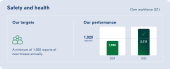
In 2025 there was more focus on the safety culture within all Royal A-ware locations. This has resulted in a much higher number of reported ‘near misses’ for 2025. This is a clear sign of a heightened alertness for safety within the organisation.
|
% to which its own workforce is covered by a safety and health management system |
Employees |
Self-employed persons, Freelancers |
People employed by a third party engaged in ‘employment activities’ |
|---|---|---|---|
|
2025 |
100% |
100% |
100% |
|
2024 |
100% |
100% |
100% |
|
2025 |
2024 |
|||||||||
|
Employees |
Self-employed persons, Freelancers |
People employed by a third party engaged in ‘employment activities’ |
Other workers on undertakings's site, for example workers in the value chain |
Total |
Employees |
Self-employed persons, Freelancers |
People employed by a third party engaged in ‘employment activities’ |
Other workers on undertakings's site, for example workers in the value chain |
Total |
|
|
The number of fatalities as a result of work-related injuries and work-related ill health |
0 |
0 |
0 |
0 |
0 |
0 |
0 |
0 |
0 |
0 |
|
Number of work-related accidents; |
112 |
11 |
35 |
0 |
158 |
177 |
||||
|
Rate of recordable work-related accidents for own workforce (x 1,000,000) |
12.7 |
96.8 |
15.7 |
- |
14.2 |
17* |
||||
|
2025 |
2024 |
|
|
Number of cases of recordable work-related ill health |
0 |
0 |
|
Number of days lost to work-related injuries and fatalities from work-related accidents, work-related ill health and fatalities from ill health |
6078 |
5249 |
